
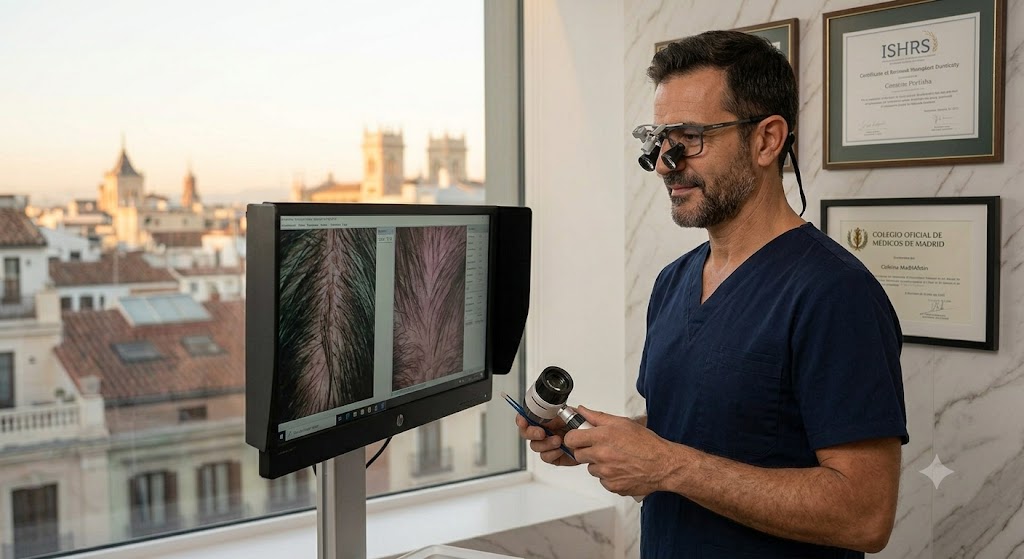
Medical Review: This content is supervised and verified by
Dr. Carlos Portinha.
Introduction: The Science of Follicular Survival
Hair transplantation has historically been viewed through a purely cosmetic lens. However, modern trichological science has reframed the procedure as a highly sophisticated, micro-vascular autograft surgery. In an advanced Follicular Unit Extraction (FUE) intervention, thousands of living tissue structures are systematically harvested, isolated, altered, and re-implanted into an entirely new anatomical site. The ultimate success of this procedure is not merely measured by the coverage achieved, but by the precise execution of rigorous quality control protocols across every single millimeter of the surgical workflow.
For patients navigating the international hair restoration market, understanding what happens inside a regulated operating room is paramount. Graft survival is governed by strict biological timelines and micro-environmental conditions. From the exact moment a follicular unit is severed from its native blood supply during extraction, a biological countdown begins. Preventing cellular death, minimizing tissue transection, and eliminating the risk of operating room contamination require an uncompromised commitment to clinical standards. This guide provides an in-depth, transparent breakdown of the advanced FUE protocols and operating room safety standards enforced by leading surgical teams in Spain to guarantee optimal, lifelong graft survival.
Phase 1: Pre-Surgical Diagnostics and Kinetic Hairline Mapping
True quality control begins long before the surgeon makes the first incision. In premium medical environments, the day of surgery opens with a rigorous cross-examination of the patient’s scalp using high-definition digital trichoscopy. This diagnostic step allows the surgical team to map the scalp’s vascular health, accurately calculate the ratio of single, double, triple, and quadruple-hair follicular units, and establish the precise boundaries of the safe donor area.
Over-harvesting is a permanent, irreversible clinical error frequently seen in unregulated clinics. To prevent this, strict quality control demands a mathematical calculation of the donor capacity. A surgeon must evaluate the safe donor zone’s density (measured in follicular units per square centimeter) and ensure that the extraction plan does not exceed 20% to 25% of the total available lifetime donor supply. Simultaneously, kinetic hairline mapping is conducted. The surgeon designs the recipient area boundary based on natural craniofacial proportions, muscle movement lines of the forehead, and age-appropriate regression models, ensuring the aesthetic plan aligns perfectly with long-term facial maturation.
Phase 2: Advanced FUE Extraction Protocols and Transection Mitigation
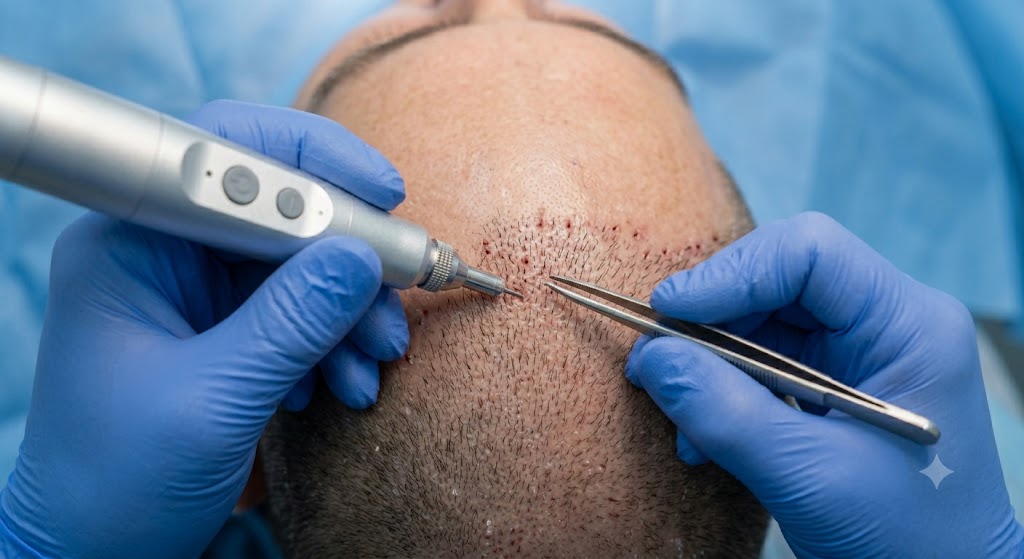
The extraction phase is a critical technical threshold where the physical skill of the surgeon directly impacts the survival rate of the grafts. The primary objective during extraction is to avoid follicular transection—the accidental cutting or tearing of the hair bulb or shaft during the micro-punch insertion.
1. Micro-Punch Instrumentation and Technology
Top-tier clinics utilize advanced motorized extraction systems equipped with custom-engineered hybrid or serrated micro-punches (ranging tightly between 0.7mm and 0.85mm in diameter). The selection of the punch diameter is customized to the patient’s specific tissue characteristics. A punch that is too wide increases donor scarring and healing timelines, while a punch that is too narrow drastically elevates the risk of mechanical transection. Motorized systems must feature precise torque control and sub-millimeter oscillation settings to cut smoothly through the surrounding arrector pili muscle without transferring excessive heat or torsional stress to the delicate hair follicles.
2. Depth and Angle Alignment
Human hair follicles do not grow completely perpendicular to the scalp surface; they exit at varying angles and curves, particularly in curly or wavy hair types. The operating surgeon must constantly adjust the axis of the micro-punch to match the exact subcutaneous exit angle of each individual follicle. Quality control parameters dictate that the punch should only penetrate the top third of the dermis (approximately 2.5mm to 3mm deep). Once the superficial attachment is cut, the remaining deeper structures of the follicular unit are gently liberated using micro-forceps, preserving the vital surrounding adipose tissue and outer root sheath.
Phase 3: The Ex Vivo Stage – Graft Preservation and Holding Solutions
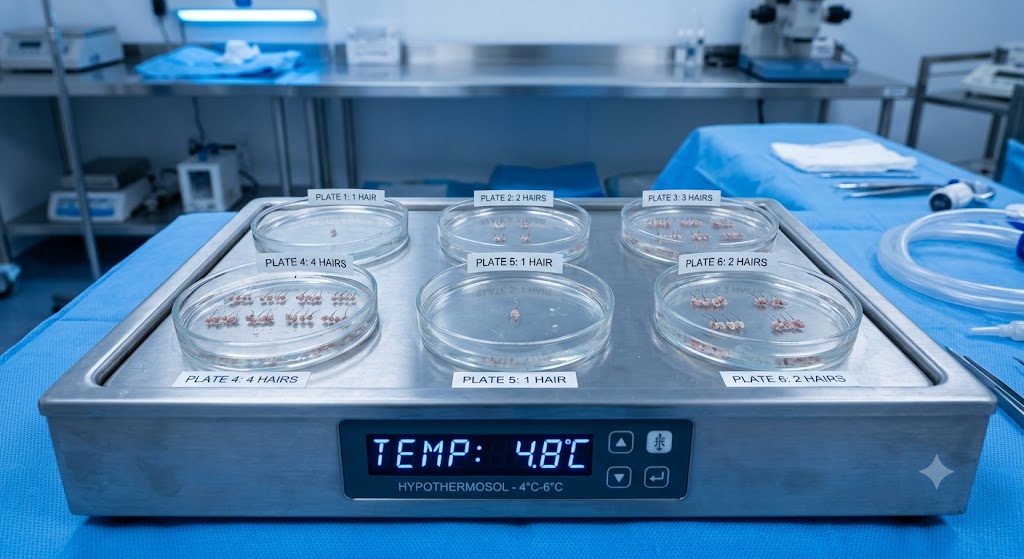
Once extracted from the scalp, hair follicles enter the most vulnerable stage of the surgery: the ex vivo (outside the body) phase. Deprived of oxygen, nutrients, and active blood circulation, the tissue undergoes immediate ischemic stress. Left unprotected, cells begin to degrade rapidly, leading to poor growth or complete graft failure post-implantation.
1. Temperature Stabilization
To slow down cellular metabolism and drastically reduce the follicle’s oxygen consumption, grafts must be kept in a state of controlled hypothermia. Immediately upon harvesting, specialized clinical technicians transfer the follicles into chilled Petri dishes placed over digital cooling plates or ice beds. The target temperature must be kept strictly between 4°C and 6°C. Fluctuations outside this narrow window can trigger thermal shock or premature cell necrosis.
2. Advanced Holding Solutions (Bio-Preservation Media)
Historically, standard normal saline (0.9% NaCl) was used to store grafts. Modern quality control standards have abandoned this practice, as saline lacks vital osmotic and biochemical buffering capacities. Premium clinics use specialized bio-preservation solutions, such as HypoThermosol® or chilled Ringer’s Lactate, frequently enriched with adenosine triphosphate (ATP) liposomes or Autologous Platelet-Rich Plasma (PRP).
These advanced holding media are clinically formulated to:
- Maintain correct intracellular osmotic pressure, completely preventing cell swelling and membrane rupture.
- Provide vital antioxidants to neutralize free radicals generated during the ischemia phase.
- Supply direct cellular energy substrates, minimizing the impact of ischemia-reperfusion injury when the grafts are re-implanted into the recipient site.
| Storage Metric | Standard Protocol | Clinical Objective |
|---|---|---|
| Temperature Range | 4°C to 6°C | Reduces metabolic rate and cellular oxygen demand. |
| Storage Solution | HypoThermosol / Ringer’s + ATP | Prevents cellular swelling and blocks ischemic oxidative stress. |
| Maximum Out-of-Body Time | 120 to 240 minutes | Ensures optimal graft survival prior to re-vascularization. |
Phase 4: Micro-Channeling and Recipient Site Engineering
The creation of the recipient sites (micro-channels) determines the density, natural direction, angle, and overall visual success of the hair transplant. This phase requires supreme surgical precision to protect the scalp’s existing blood circulation.
Leading surgeons in Spain prioritize the use of custom-cut Sapphire blades over traditional steel scalpel blades. Sapphire blades are crafted from single-crystal synthetic sapphires, creating an incredibly sharp, smooth, and rigid edge. This advanced material profile allows the surgeon to create perfectly micro-sized, smooth incisions that generate up to 40% less tissue trauma compared to steel.
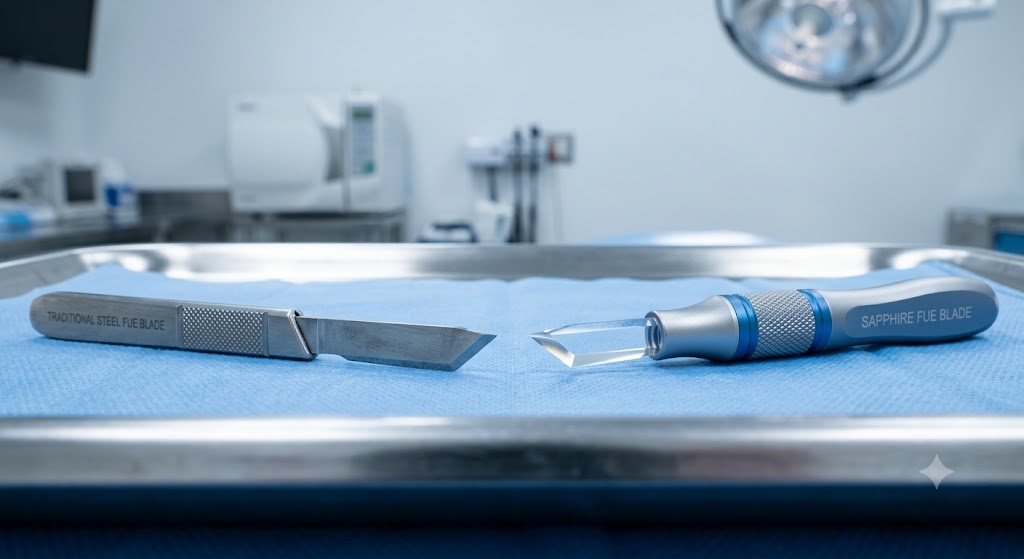
The clinical benefits of this protocol include:
- Vascular Preservation: The precise cuts protect the delicate sub-epidermal plexus of blood vessels, ensuring immediate nutrient delivery to the new grafts.
- Higher Density Placement: Cleaner incisions mean channels can be placed closely together without causing lateral tissue tearing or lifting neighboring grafts.
- Reduced Post-Op Edema: Less localized trauma directly translates to significantly faster healing timelines, lower scab formation, and minimal swelling for the patient.
Operating Room Safety Standards and EU Regulatory Compliance
Patient safety cannot be separated from surgical quality control. In Spain, all hair restoration surgeries must be performed within clinical operating suites that hold explicit authorization from regional health departments, fully complying with rigorous European Union medical mandates.
Every accredited operating room must enforce the following absolute safety parameters:
- Air Quality and Ventilation: The surgical suite must utilize specialized positive-pressure ventilation equipped with medical-grade HEPA filters to maintain an entirely sterile air environment, removing 99.97% of airborne pathogens.
- Autoclave Sterilization Traceability: Every surgical instrument kit undergoes strict, documented autoclave steam sterilization. Electronic indicator strips verify that the kit has reached the required temperature and pressure thresholds to completely eliminate all bacterial spores, viruses, and fungi.
- Comprehensive Emergency Response Infrastructure: Because local anesthetics carrying cardiovascular active agents are routinely administered, the operating suite must be fully stocked with emergency resuscitation equipment, including an Automated External Defibrillator (AED), emergency airway management kits, and an immediate supply of cardiac emergency medications.
Conclusion: Choosing a Standards-Driven Clinic
When selecting a hair restoration clinic, patients must look beyond superficial commercial offers and analyze the underlying clinical architecture. The difference between an average result and an elite, natural, lifetime transformation lies entirely within the clinic’s quality control discipline. By choosing institutions that utilize premium bio-preservation holding solutions, leverage advanced punch and sapphire technology, and operate under strict EU sterilization mandates, patients can confidently ensure their hair transplant is executed with the highest level of medical safety and artistic excellence available today.
Leave a Reply