
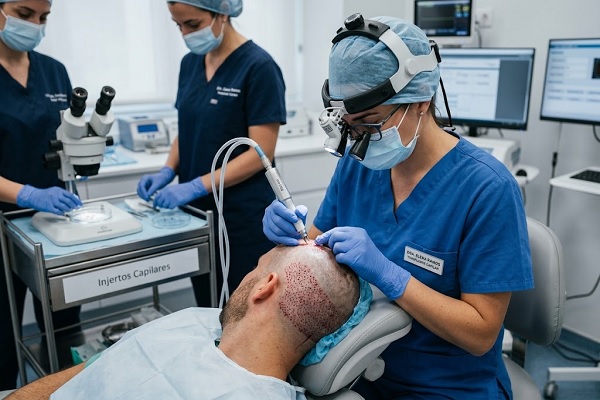
The legality of hair graft extraction in Spain remains ambiguous for many international patients. Understanding the regulatory framework governing this capillary procedure is the first crucial step before booking a surgery. Since the distinction between doctors and technicians is often misunderstood, this article clarifies who holds the legal authority to perform follicular harvest under Spanish health regulations.
Who Actually Extracted Your Hair Grafts?
Patients often overlook a critical detail during hair transplants: who performs hair graft extraction? In Spain, law treats follicle harvest as invasive surgery. Therefore, doctors must execute every incision. However, clinics in Turkey or the UK frequently let technicians perform this crucial task.
Hair Transplant Spain Law: Why the Person Holding the Punch Matters
Spanish Law 44/2003 assigns all surgical treatments strictly to doctors. Furthermore, regulation U.47 defines aesthetic surgery as a medical activity. A surgeon must perform each hair graft extraction directly. Consequently, clinics cannot delegate incisions to uncertified staff. Correct hair graft extraction requires surgical expertise, formal qualifications, and strict medical responsibility.
Hair Technicians in Spain: What Does the Law Actually Allow?
Spanish legislation does not recognize “hair technicians” as independent surgical professionals. Technicians assist during surgery, but they cannot make incisions. A technician doing hair graft extraction violates health regulations, regardless of experience. Foreign clinics allow technicians to execute hair graft extraction, yet Spain forbids it. Safe hair graft extraction demands a licensed doctor to protect patient rights and safety.
FUE Hair Transplant in Spain: Extraction Is Not Just a Cosmetic Task
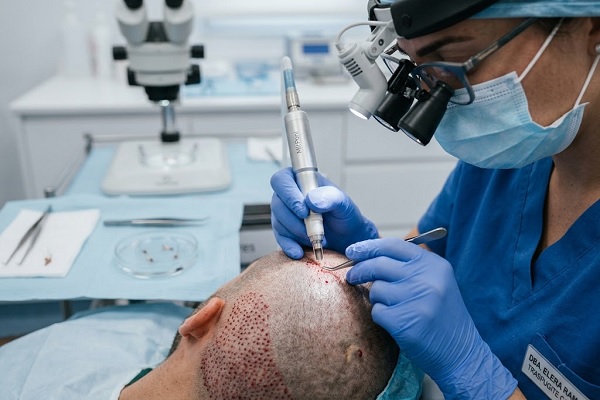
FUE, or Follicular Unit Extraction, involves removing individual follicular units from the donor area. The process commonly involves:
- Identifying the donor area.
- Preparing and disinfecting the scalp.
- Administering local anaesthesia.
- Positioning the extraction instrument.
- Creating the necessary access around the follicular unit.
- Executing the hair graft extraction process.
- Managing the extracted tissue.
- Preparing the recipient area.
- Creating recipient sites.
- Implanting the grafts.
The distinction between these stages matters legally. Some tasks are preparatory or supportive. Others, such as precise hair graft extraction, involve invasive manipulation or surgical intervention. Spanish healthcare regulations define minor ambulatory surgery as a healthcare unit where, under the responsibility of a doctor, low-complexity and minimally invasive therapeutic or diagnostic procedures are performed.
Therefore, patients should not assume that because FUE uses a small punch rather than a traditional surgical incision, the procedure ceases to be surgical. Small instruments do not automatically make an invasive procedure non-surgical.
Can a Hair Technician Extract Grafts in Spain?
The safest legal answer is more precise than simply saying “yes” or “no.” A non-doctor cannot acquire an independent surgical scope merely by calling themselves a hair technician or completing a private hair-transplant course.
Spanish law allows healthcare teams to work collaboratively and provides for delegation when the recipient has the necessary competence. However, that delegation must remain within the lawful professional scope of the person receiving it. At the same time, Spain’s regulatory framework identifies the doctor as responsible for surgical aesthetic treatments involving hair. This creates an important distinction:
| Situation | Legal significance in Spain |
| Doctor diagnoses and plans the procedure | Core medical responsibility |
| Doctor performs surgical steps | Clearly within medical practice |
| Qualified healthcare professional assists the medical team | Potentially compatible with multidisciplinary practice |
| Technician performs tasks within their lawful competence | Depends on qualification and specific task |
| Private course creates a new surgical professional scope | No |
| Non-qualified person independently performs invasive surgery | High legal and patient-safety concern |
| Clinic cannot identify who performed extraction | Major transparency red flag |
Who Is Legally Responsible for a Hair Transplant in Spain?
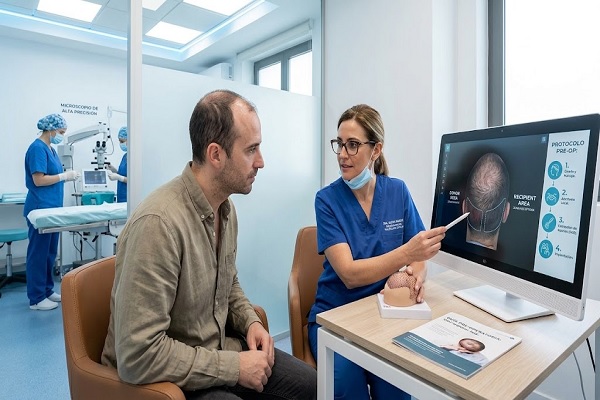
Responsibility does not disappear because a clinic divides the procedure between several people. The Spanish healthcare framework requires centres to ensure that patient care is provided by professionals with the official qualifications and competencies appropriate to the assistance provided. Since July 2026, this requirement has been reinforced through amendments to the rules governing healthcare centres and establishments.
This is particularly relevant for hair-transplant clinics: “a doctor is somewhere in the building” is not the same thing as genuine, direct medical involvement.
Hair Transplant Spain Law vs Other Countries
Spain is not the only country where hair-transplant clinics use multidisciplinary teams. However, the legal boundaries differ considerably. That difference explains why patients can encounter apparently contradictory claims online. A technician performing follicular extraction may be lawful in one jurisdiction while creating serious regulatory concerns in another.
| Country | Doctor involvement | Technician involvement | Key point |
| Spain | Central to surgical aesthetic treatment | Depends on qualification and lawful delegation | Official competence matters; private training alone does not create surgical authority |
| Turkey | Required for defined surgical stages | Certain certified healthcare professionals may assist with specific stages | Regulations expressly establish certified assistant roles |
| United Kingdom | Strong medical oversight | Surgical steps are tightly regulated | CQC materials identify surgical hair-transplant steps as doctor-performed |
| United States | Depends on state law | Can vary considerably | No single nationwide rule governs every delegation scenario |
Hair Transplant Technicians in Turkey: A Different Regulatory Model
Turkey allows certified technicians to perform hair graft extraction. However, Turkish law reserves channel creation strictly for doctors. This model relies on specific assistant certifications.
Hair Transplant Surgery in the UK: Why the Rules Look Different
The UK Care Quality Commission regulates invasive capillary surgery. General Medical Council rules require doctors to execute surgical incisions. Therefore, UK regulations forbid technicians from performing hair graft extraction independently.
Hair Transplant Technicians in the USA: State Law Changes Everything
The United States regulates surgical delegation at the state level. Consequently, rules vary significantly across state medical boards. Some states permit supervised assistance, while others restrict invasive tasks strictly to surgeons.
Final Verdict: Ask Before You Sit in the Chair
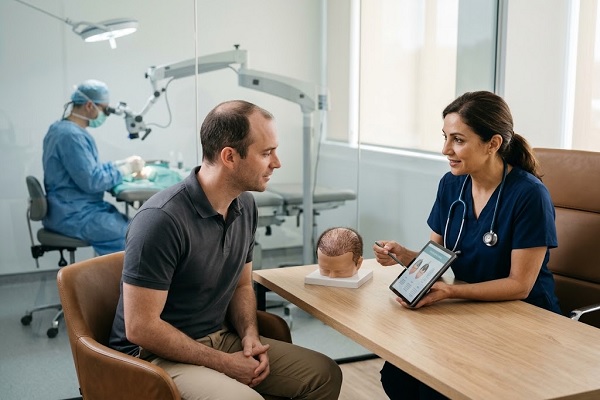
Hair transplantation has become increasingly accessible. However, accessibility should never come at the expense of transparency. Spain’s regulatory framework treats surgical aesthetic and capillary procedures as healthcare activities requiring appropriately qualified professionals. Since July 2026, Spanish healthcare-centre rules have further reinforced the requirement for qualified professionals with appropriate competencies.
Meanwhile, other countries follow different models. Turkey explicitly regulates certified assistant roles. The UK places strong emphasis on medical professionals performing surgical hair-transplant steps. The United States leaves many questions to individual state rules.
Frequently Asked Questions About Hair Graft Extraction in Spain
Can a hair technician legally perform FUE extraction in Spain?
What role can technicians play during a hair transplant in Spain?
Why do technicians perform graft extractions in Turkey but not in Spain?
Medical fact-checked by the SpainHairIndex Editorial Team.
Looking for Doctor-Led Hair Restoration in Spain?
Compare accredited clinics in Madrid, Barcelona, and Valencia where certified surgeons handle all surgical steps directly.
Leave a Reply