
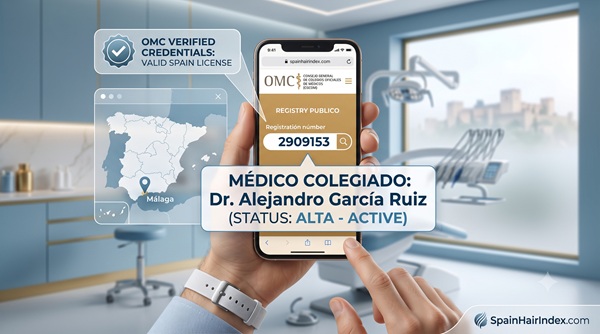
Patient Safety Notice: In Spain, performing any surgical hair restoration without a valid medical license and registration is illegal. This guide shows you exactly how to verify your doctor’s credentials in under two minutes.
Introduction: The Non-Negotiable Standard of Hair Transplant Safety
Spain has rapidly emerged as a premier European destination for high-quality hair transplant surgery. Attracted by world-class clinics, cutting-edge FUE and DHI technologies, and rigorous European medical standards, thousands of international patients trust Spanish practitioners with their scalps every year. However, as the market expands, so does the risk of encountering low-cost “hair mills” where unlicensed technicians quietly perform surgeries under the radar.
In hair restoration, your surgeon’s credentials are your ultimate safety net. A hair transplant is not a simple cosmetic treatment—it is a micro-surgical procedure involving thousands of tiny incisions, local tumescent anesthesia, and strict donor management. To legally practice medicine in Spain, every single doctor must be registered with the Organización Médica Colegial (OMC). If a practitioner cannot or will not provide their OMC registration number, you should not let them touch your hair.
What is the OMC Registration Number (Número de Colegiado)?
The Organización Médica Colegial (OMC) is the national governing body that regulates all licensed medical doctors in Spain. When a doctor graduates from medical school, completes their residency, and meets all legal requirements to practice, they are assigned a unique, permanent registration number known as the Número de Colegiado.
This number is not a mere formality; it is a legal requirement. It tells you three critical pieces of information:
- Legal Authorization: It proves the doctor is legally authorized to practice medicine on Spanish soil.
- Province of Practice: The first two digits of the number indicate the Spanish province where the doctor originally registered (e.g., 28 for Madrid, 08 for Barcelona, 29 for Málaga).
- Active Medical Standing: It confirms that the doctor’s license is active, in good standing, and has not been suspended due to malpractice or ethical violations.
Step-by-Step Guide: How to Verify Your Spanish Surgeon Online
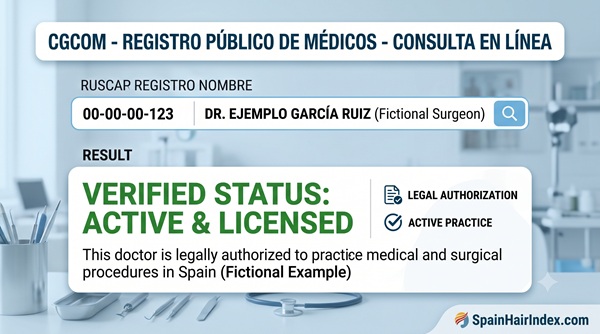
Verifying your doctor’s licensing status in Spain is a straightforward, transparent process that can be completed entirely online. You do not need to speak Spanish to navigate the registry. Follow these simple steps:
Step 1: Get the Surgeon’s Full Name and Registration Number
Before booking your procedure, ask the clinic directly for the surgeon’s full name and their Número de Colegiado. Any ethical, board-certified surgeon in Spain will gladly provide this information. If the clinic hesitates, makes excuses, or claims that “the clinical team operates under a general license,” treat this as a massive red flag.
Step 2: Access the Official OMC Public Registry
Go to the official public portal of the Spanish Medical Colleges: cgcom.es (Consejo General de Colegios Oficiales de Médicos). This is the centralized database of every active doctor in the country.
Step 3: Enter the Details
The search interface is highly intuitive. You can search using either:
- The surgeon’s registration number (Número de Colegiado) in the designated field.
- Their first and last names (Nombre y Apellidos).
Tip for International Patients: Spanish naming conventions usually involve two last names (e.g., Dr. Javier Gómez Ruiz). For the most accurate search results, try searching with just the registration number, as spelling variations in names can sometimes cause search misses.
Step 4: Analyze the Results
Once you click search, the system will display the doctor’s file. Verify that:
- The name matches your surgeon exactly.
- Their status is listed as “Alta” (Active/Registered) rather than “Baja” (Inactive/Unregistered).
- The specialized medical training matches the procedures they are offering.
Why Technician-Only Surgery is a Danger to Your Scalp
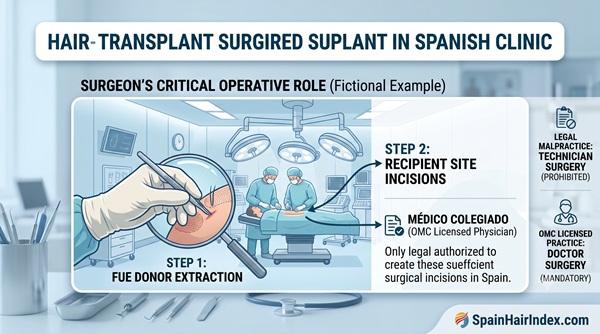
A common malpractice loop in cosmetic tourism involves “technician-only” surgeries. In these scenarios, a fully licensed doctor with a valid OMC number conducts your initial consultation, signs the paperwork, and leaves the room. The actual extractions and incisions—the surgical phases—are then performed by medical assistants or technicians who lack surgical qualifications.
Under Spanish law, medical technicians are strictly prohibited from making incisions or extracting hair follicles. Doing so constitutes a criminal offense of professional intrusion (intrusismo profesional). When selecting your clinic on SpainHairIndex, always ask: “Who is performing the extractions and creating the recipient channels, the surgeon or a technician?” An ethical clinic will guarantee that the licensed surgeon performs all critical surgical steps.
Questions to Ask Your Spanish Clinic Before Booking
To protect your safety and ensure an optimal, natural-looking result, always send these direct questions to your clinic’s coordinator during your consultation phase:
- What is the full name and OMC registration number of the surgeon who will lead my procedure?
- Will the surgeon be in the operating room performing the donor extractions and recipient site incisions personally?
- In which medical college in Spain is the doctor registered? (e.g., Colegio Oficial de Médicos de Madrid – COMM, or Barcelona – COMB).
- Does the clinic carry comprehensive medical malpractice insurance covering foreign patients?
Conclusion: Demand Transparency for a Lifetime Result
Your hair transplant is a permanent change to your appearance and a significant financial and emotional investment. You deserve complete transparency. Spain offers some of the most talented, highly regulated, and ethically disciplined hair transplant surgeons in the world. By taking two minutes to verify your doctor’s OMC registration number, you eliminate the risk of illegal clinics and guarantee that your scalp is in highly qualified hands.
At SpainHairIndex, we do not partner with high-volume, low-cost “mills.” We verify, vet, and list only accredited clinics in Spain led by licensed, board-certified surgeons who prioritize patient safety and natural, life-changing density.
Browse Our Vetted, Licensed Hair Transplant Clinics in Spain Today
Leave a Reply