
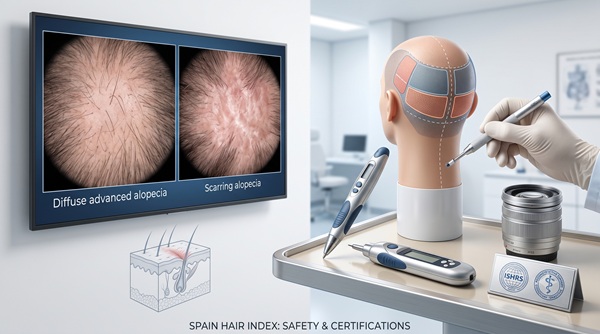
When dealing with standard hair restoration cases, most modern clinics can deliver satisfactory results using automated protocols. However, when a patient presents with advanced alopecia (Norwood Scale 6 or 7) or extensive scalp scarring—whether from trauma, burns, medical conditions, or previous poorly executed surgeries—the clinical approach must shift entirely. These scenarios represent high-complexity cases where standard procedures are not only insufficient but can also lead to irreversible donor depletion or severe skin damage.
For patients navigating these challenging conditions, finding the right clinic requires looking beyond aggressive marketing and commercial discounts. From a safety, medical certification, and clinical efficacy standpoint, here is an objective breakdown of the rigorous criteria a hair transplant clinic must meet to successfully treat advanced hair loss and scarred tissue.
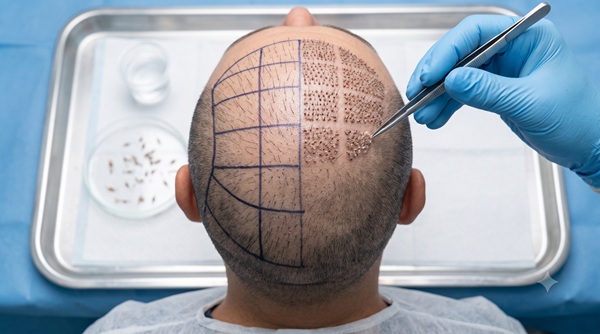
1. Advanced Management of a Depleted Donor Area
In advanced alopecia (Norwood 6/7), the fundamental challenge is a severe mathematical mismatch: the patient has an massive recipient area to cover but a highly restricted donor zone. A premium, high-complexity clinic will never promise complete, dense coverage in a single standard session. Instead, look for institutions that master the following safety protocols:
- Megasessions and Strategic Planning: High-end medical teams plan the restoration over multiple stages or sequential days. This prevents over-harvesting, ensuring the donor area remains healthy and does not develop a “moth-eaten” appearance or permanent donor alopecia.
- Body Hair Transplantation (BHT) Mastery: When scalp donor hair is insufficient, advanced clinics utilize body hair (from the beard, chest, or torso) via BHT. Harvesting from these alternative zones requires highly specialized punch sizes, depth controls, and specific extraction angles that standard technicians cannot execute safely.
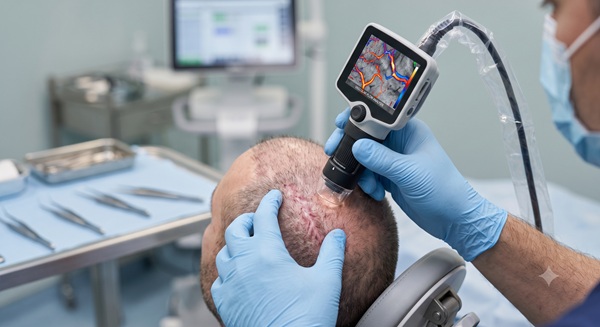
- Strict Donor Capacity Micro-Mapping: Prior to any extraction, the clinical team must use digital trichoscopy to calculate the exact follicular unit density per square centimeter. This mathematically determines the safe extraction limit without risking donor necrosis or hyper-hypopigmentation.
2. Surgical Approach to Scarring and Fibrotic Tissue
Implanting hair follicles into scarred tissue—whether caused by past trauma, surgeries, or underlying scarring alopecias (such as Frontal Fibrosing Alopecia or Lichen Planopilaris)—is one of the most technically demanding tasks in reconstructive dermatology. The biological environment of a scar is entirely different from healthy skin.
The Physiological Challenge of Scar Tissue
Healthy skin is rich in blood vessels, providing constant oxygen and nutrients to hair roots. Scar tissue, conversely, is fibrotic, thick, and poorly vascularized (hypovascular). If a clinic applies standard depth and pressure when creating incisions, the transplanted grafts will fail to survive due to a lack of blood supply.
To ensure patient safety and graft survival on scars, a clinic must demonstrate competency in:
- Vascularization Assessments: The medical team should evaluate the thickness and blood flow of the fibrotic tissue before planning the density. In some advanced protocols, clinics perform a small “test patch” of a few dozen grafts months before the full procedure to verify survival rates.
- Customized Implantation Depth and Angle: Scar tissue can be either thin and atrophic or thick and hypertrophic. The surgeon must manually adapt the depth of every single incision or use specialized implanter pens (DHI technique) to avoid hitting deeper cranial structures or placing the graft too superficially.
- Prerequisite Inflammatory Stability: If the scar is the result of an active autoimmune condition (like Lichen Planopilaris), a certified clinic will refuse to operate until a dermatologist certifies that the disease has been clinically silent and biopsy-proven inactive for at least 12 to 24 months.
3. Elite Medical Certifications and Staff Credentials
In the hair transplant industry, low-cost commercial centers often relegate the entire surgical procedure to technicians or nurses, with the doctor only appearing for a brief consultation. In high-complexity cases, this practice is a massive safety hazard.
When auditing a clinic’s safety standards, patients should verify the following institutional and individual credentials:
-
- Active International Medical Affiliations: The lead operating surgeons should hold active, verified memberships in recognized scientific bodies, such as the International Society of Hair Restoration Surgery (ISHRS) or national equivalents focused on plastic and reconstructive surgery. Membership ensures the surgeon is bound by strict ethical codes and updated on complex reconstructive techniques.
- Dedicated Reconstructive Portfolios: A reputable center will be able to present blinded, medically documented case studies showing long-term (12-18 months) evolution of patients with advanced baldness or severe tissue scarring.
- Advanced Hospital-Grade Infrastructure: High-complexity cases require longer operating times, sometimes exceeding 8 hours. The clinic must be fully equipped with advanced patient monitoring systems, emergency resuscitation equipment, and strict sterile air-flow controls that exceed standard outpatient requirements.
4. Realistic Management of Expectations
Perhaps the ultimate sign of safety and ethical certification in a hair clinic is their refusal to over-promise. In advanced alopecia and scar reconstructions, achieving the density of a teenager is biologically impossible.
An ethical, top-tier medical team will focus on creating a natural, age-appropriate hairline, maximizing visual illusion of density, and effectively blending scarred areas into the surrounding hair. If a clinic guarantees 100% graft survival on a heavy scar or promises a dense mane to a Norwood 7 patient, it is a significant red flag indicating commercial interest over patient safety.
Conclusion
Treating advanced hair loss and scalp scars is a matter of reconstructive medicine, not just cosmetic enhancement. Patients facing these complex situations should look for centers that prioritize mathematically sound donor planning, possess specific technological tools for fibrotic tissue, and are led by internationally accredited surgeons who physically perform the surgical steps. True safety lies in rigorous medical customization, not in automated, mass-produced surgeries.
Leave a Reply