When evaluating the standards of a hair transplant clinic in Spain, aesthetic expertise and high graft survival rates are only part of the equation. Behind the scenes of every successful Follicular Unit Extraction (FUE) or Direct Hair Implantation (DHI) procedure lies a fundamental priority: uncompromising medical safety.
Although minor outpatient surgeries are statistically safe, local anesthetics and prolonged procedural times carry inherent systemic risks, such as anaphylactic reactions, vasovagal syncope, or cardiac events. In Spain, health authorities enforce strict regulatory frameworks governing outpatient surgery suites (Unidades de Cirugía Mayor y Menor Ambulatoria).
In this article, we outline the mandatory lifesaving equipment, emergency crash carts, and resuscitation protocols that every accredited Spanish hair clinic must maintain by law.
Key Safety Highlights in Accredited Spanish Clinics:
- Legal Mandate: Regional health ministry authorizations (Autorización Sanitaria) mandate fully equipped emergency resuscitation setups for minor surgery operating rooms.
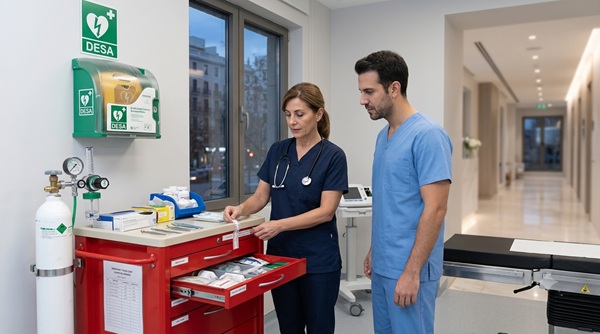
- DESA / AED Availability: Automated External Defibrillators must be accessible with zero response latency.
- Crash Cart Standards: Standardized emergency medication kits including epinephrine, atropine, and antiarrhythmics.
- Oxygen & Airway Management: Dedicated medical oxygen delivery systems and advanced airway tools (laryngeal masks, endotracheal tubes).
The Legal Framework: Spanish Health Regulations for Minor Surgery
In Spain, hair transplantation falls under the classification of minor outpatient surgery requiring local anesthesia and mild sedation. To obtain and maintain an official Operating License (Autorización Sanitaria / Registro de Centros Sanitarios), a clinic must strictly comply with regional health department decrees (such as Royal Decree 1277/2003 at the national level and regional healthcare regulations).
These regulations dictate that any facility conducting surgical interventions—regardless of invasiveness—must be fully equipped to handle medical emergencies, advanced life support (ALS), and immediate patient stabilization prior to emergency transfer.
1. The Emergency Crash Cart (Carro de Parada)
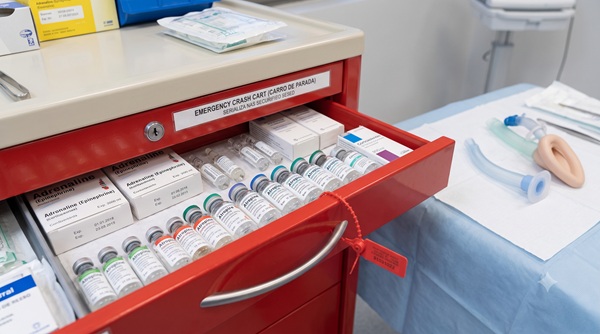
The primary defense against acute intraoperative complications is the medical emergency crash cart. In accredited Spanish clinics, this mobile, sealed unit must be situated directly inside or immediately adjacent to the surgical suite.
Core Emergency Medications
The cart must contain non-expired, sealed first-line emergency drugs, including:
- Epinephrine (Adrenaline): Critical for managing acute anaphylactic shock from local anesthetics or antibiotics, as well as cardiac arrest.
- Atropine: Used to manage severe intraoperative bradycardia (abnormally low heart rate caused by vasovagal responses).
- Antihistamines & Corticosteroids: High-dose intravenous dexamethasone or hydrocortisone to treat severe allergic reactions.
- Anticonvulsants (Benzodiazepines): Diazepam or midazolam to treat potential Local Anesthetic Systemic Toxicity (LAST) seizures.
- Antiarrhythmics & Bronchodilators: Amiodarone and inhaled salbutamol for cardiac dysrhythmias and acute bronchospasms.
2. Defibrillation & Cardiac Monitoring (DESA)
Sudden cardiac events during surgery require rapid intervention. Spanish legislation mandates the presence of an Automated External Defibrillator (DESA – Desfibrilador Externo Semiautomático) in outpatient facilities.
- Response Window: The DESA must be operational and capable of delivering a therapeutic shock within 3 minutes of collapse.
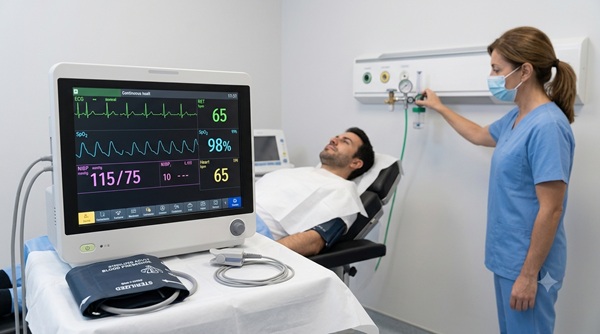
- Integrated ECG Monitoring: Advanced clinics utilize multi-parameter cardiac monitors that continuously track non-invasive blood pressure (NIBP), pulse oximetry (SpO2), and continuous electrocardiogram (ECG) readouts throughout the entire 6 to 8-hour hair transplant procedure.
3. Airway Management & Oxygen Systems
Hypoxia and respiratory arrest are the most time-critical medical emergencies. Spanish surgical standards dictate a dual-source oxygen management infrastructure:
| Equipment Type | Technical Specifications | Clinical Purpose |
|---|---|---|
| Medical Oxygen Source | Centralized flowmeters + auxiliary portable cylinder | Continuous high-flow oxygen delivery during acute respiratory distress. |
| Manual Resuscitation Bag | Self-inflating Ambu-bag with reservoir & masks | Positive pressure ventilation during apnea or severe respiratory failure. |
| Advanced Airway Tools | Guedel airways, Laryngeal Masks (LMA), Intubation kit | Securing an unobstructed airway in unconscious or uncommunicative patients. |
| Medical Suction Unit | High-vacuum electric or pneumatic aspirator | Clearing blood, secretions, or vomit from the upper airway to prevent aspiration. |
4. Intravenous Access & Haemodynamic Support
Maintaining fluid balance and guaranteeing immediate vascular access is mandatory during prolonged hair restoration operations.
- IV Cannulation Kits: Clinics must maintain pre-sterilized intravenous lines, catheters, and infusion pumps.
- Plasma Expanders & Saline Solutions: Immediate availability of 0.9% Normal Saline and Ringer’s Lactate solutions to treat sudden hypotension or hypovolemia.
Staff Training & Protocol Verification
Lifesaving equipment is only as effective as the clinical team operating it. Under Spanish health inspection standards:
- BLS & ALS Certification: Surgeons, medical doctors, and nursing staff (Graduados en Enfermería) must hold valid Basic Life Support (BLS) and Advanced Life Support (ALS) certifications.
- Periodic Audits: Crash cart seal numbers, drug expiration logs, and DESA battery maintenance cycles are audited regularly by regional health inspectors.
Frequently Asked Questions About Emergency Protocols in Spain
Are hair transplant procedures in Spain safe?
What is Local Anesthetic Systemic Toxicity (LAST) and how is it managed?
How can I verify if a clinic in Spain has an official operating license?
Medical fact-checked and reviewed by SpainHairIndex Editorial Board
Leave a Reply