
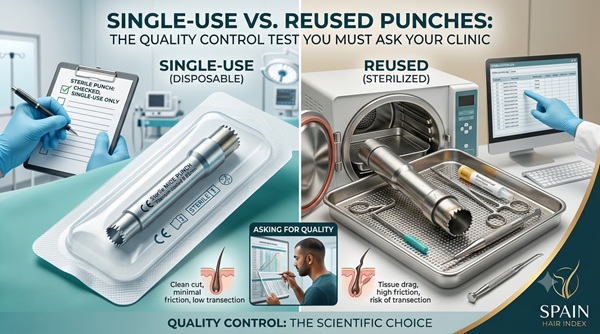
Are you planning a hair transplant in Spain? Discover why the surgical punch used for FUE extraction matters, the hidden risks of reused instruments, and the key questions to ask your clinic.
When researching a hair transplant, most patients spend weeks comparing before-and-after photos, reading patient reviews, and evaluating graft counts. However, very few ask about the microscopic tool responsible for extracting thousands of delicate hair follicles from their donor area: the FUE punch.
In Follicular Unit Extraction (FUE), the surgical punch is the micro-instrument—typically measuring between 0.7mm and 0.9mm in diameter—that cuts around each individual graft before it is harvested.
While it might seem like a minor detail, whether your surgeon uses a brand-new, single-use punch or a sterilized, reused one directly impacts your transection rate, graft survival, donor area scar pattern, and overall result.
Here is the exact scientific breakdown of single-use vs. reused punches, why blade dullness is the hidden enemy of successful hair restoration, and how to verify your clinic’s quality control standards in Spain.
The Physics of Extraction: Why Punch Sharpness Matters
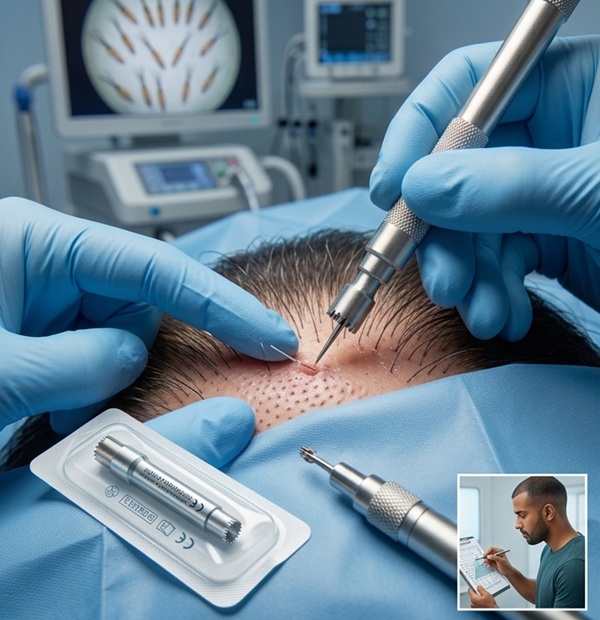
A surgical punch operates at high rotational or oscillational speeds to separate the hair follicle from the surrounding scalp tissue. To perform a clean, friction-free cut, the circular edge of the punch must be razor-sharp at a microscopic level.
What Happens When a Punch Is Reused?
Even after a single surgical session (extracting 2,500 to 4,000 grafts), the delicate cutting edge of a metallic punch experiences microscopic wear, micro-burrs, and dullness due to repeated contact with dense skin collagen and connective tissue.
If that same punch is autoclaved (sterilized) and used on a second or third patient, the consequences are immediate:
- Higher Transection Rates: A dull punch does not cut cleanly; it pulls, twists, and drags the tissue. This increases follicle transection—meaning the root of the hair is accidentally severed during extraction and will never grow back.
- Micro-Tear Damage & Scarring: Clean cuts heal with virtually invisible white micro-dots. Dull cuts cause jagged micro-tears in the donor area, leading to elevated inflammation, longer recovery times, and more visible scarring.
- Increased Heat and Friction: Mechanical friction generates localized heat. Thermal trauma to harvested grafts reduces their oxygen tolerance while waiting to be implanted, lowering the overall graft survival rate.
The Surgical Standard: A single-use, medical-grade steel or titanium punch guarantees 100% sharpness from graft #1 to graft #3,000, maintaining structural integrity and minimal tissue resistance throughout the entire procedure.
Single-Use vs. Reused Punches: A Direct Comparison
| Feature | Single-Use (Disposable) Punch | Reused (Sterilized) Punch |
|---|---|---|
| Sharpness Level | Factory-calibrated, razor-sharp edge for every graft. | Progressively duller with each extraction and sterilization cycle. |
| Cross-Contamination Risk | Zero (100% sterile, opened in front of the patient). | Low (if autoclaved correctly), but human/procedural error risks remain. |
| Tissue Trauma | Minimal friction; clean cylindrical incisions. | Higher resistance; risk of tissue twisting and micro-tearing. |
| Graft Transection Rate | Consistently low (< 3–5%). | Higher risk (> 8–15% depending on blade wear). |
| Donor Healing Time | Faster closure of micro-incisions (typically 5–7 days). | Prolonged redness and potential micro-fibrosis. |
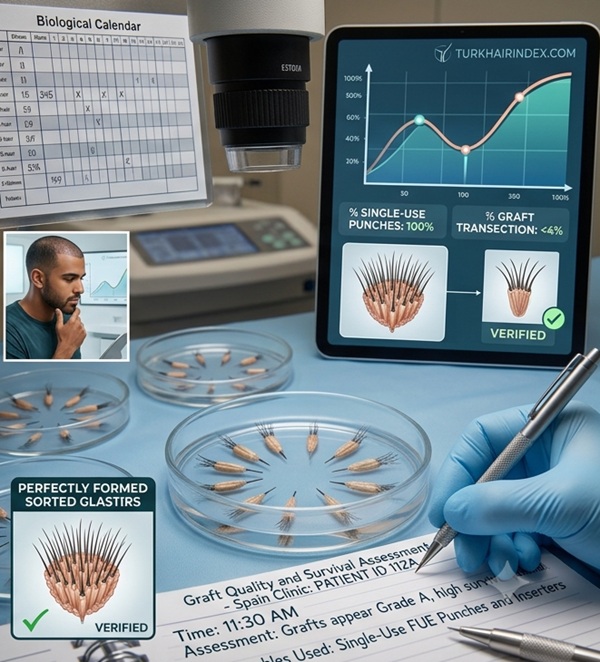
The Quality Control Test: Questions to Ask Your Surgeon
Top clinics in Spain that prioritize patient safety and high graft yield have no hesitation in discussing their surgical instruments. During your initial consultation or pre-op assessment, ask these three direct questions:
1. “Do you use single-use, disposable punches for every patient?”
- What you want to hear: “Yes, we open a new, sealed, sterile single-use punch for every session in front of the patient.”
- Red Flag: “We sterilize high-grade reusable punches that last for multiple sessions.” (Sterilization kills bacteria, but it cannot restore a dull cutting edge).
2. “What brand and material of punches do you use?”
- What you want to hear: Reputable medical-grade manufacturers such as WAW FUE system (Cole/Devroye style), MANUAL/MOTORIZED serrated punches, or Titanium/Surgical Steel single-use tips.
3. “Can I see the sterile packaging being opened before my procedure begins?”
- A transparent, patient-centric clinic will happily show you the sealed blister pack containing your punch and surgical consumables before starting the extraction phase.
Medical Quality Standards in Spain
Spain has become one of the premier European destinations for hair restoration, governed by strict European Union health regulations (CE marking for medical devices) and oversight from the Spanish Ministry of Health (Ministerio de Sanidad).
While European medical standards are among the highest in the world, clinic protocols still vary based on surgical philosophy and operational transparency. Ensuring that your chosen clinic utilizes single-use surgical instruments is one of the most effective ways to separate elite medical centers from high-volume “graft factories.”
The Bottom Line
Your donor area is a finite resource. Once a hair follicle is transected or damaged due to dull instrumentation, it cannot be replaced.
Demanding single-use, high-precision punches is not about being overly cautious—it is an essential quality control step that protects your investment, minimizes donor scarring, and ensures maximum density in your final hair transplant result.
Are you evaluating certified hair restoration clinics in Spain?
Explore our comprehensive directory and verified reviews across Madrid, Barcelona, Valencia, and Seville to compare medical standards and patient outcomes.
Leave a Reply